
20 Coily Hairstyles That Honor Natural 4A–4C Texture
20 stunning coily hairstyles from wash-and-gos to protective styles — expert-approved looks for type 4A, 4B, and 4C hair with styling tips and product guidance.

HairLysia Editorial · Researched, written, and reviewed by the HairLysia editorial team.
Updated June 3, 2026

Coily hair — type 4A through 4C — has the tightest curl pattern, the most shrinkage, and the most versatility of any texture. The same head of hair can wear a sleek bun, a massive afro, defined finger coils, and intricate braids all in the same week. The best coily hairstyles celebrate the unique properties of this texture: its density, its spring, its ability to hold shapes that no other texture can, and its stunning visual impact.
This guide covers twenty coily hairstyles from everyday wash-and-gos to protective styles that last weeks. Each style includes specific technique and product guidance. If you are still learning your coil pattern, our complete guide to haircuts covers pattern identification and curl-type-specific recommendations.
1. The High Coily Ponytail
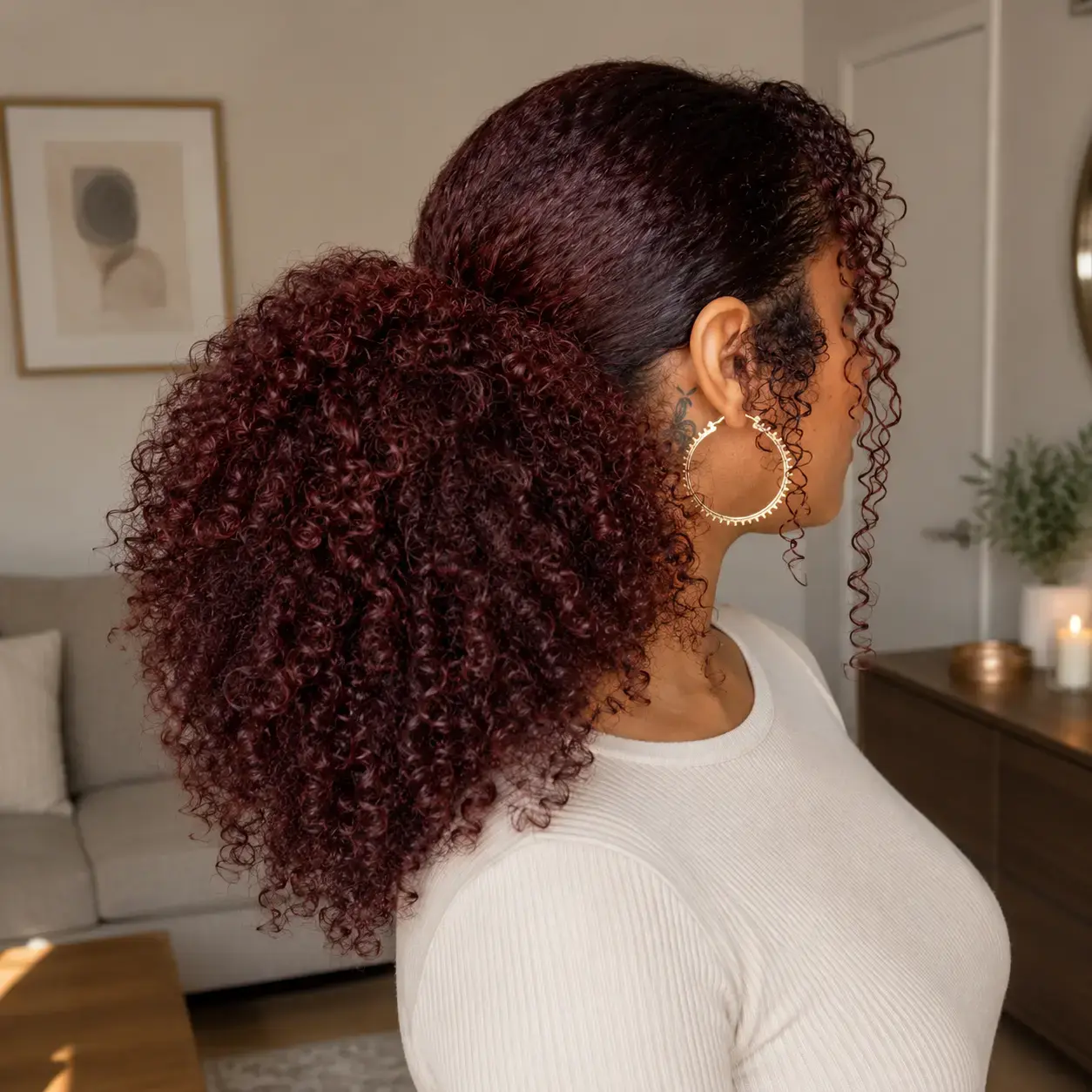
The high coily ponytail gathers everything up and back to a point above the crown, sweeping the sides smooth and letting the coils explode outward and downward from the elastic in a dense, shoulder-grazing cloud. It is the single fastest way to make type 4 volume look deliberate — the contrast between the brushed-flat sides and the mass of springy texture below the gather is what sells the whole thing. Wrap a satin scrunchie or a fabric-covered elastic at the base rather than a bare band, and leave a few spiral tendrils loose at the temples and nape so the hairline reads soft instead of severe.
Colour amplifies this shape more than almost any other. A wine-red or deep burgundy gloss over a dark base catches light differently on every coil, so the ponytail reads as dimensional rather than as one solid block — see our colour care notes if you are wearing a red like this one. The high ponytail dresses up for a wedding with a cuff or a pin at the base and dresses down for a Tuesday with nothing at all, which is why it earns the top spot. Smooth the sides with a soft brush and edge control, never a fine-tooth comb, and keep the gather high but not tight — the hairline is the first thing to protest, and tension here is the enemy of length retention.
2. The Classic Afro
The afro is the most iconic coily hairstyle — hair picked out to maximum volume and worn in its natural shape without any attempt to elongate, define, or control the texture. The afro celebrates coily hair at its biggest and boldest, creating a stunning silhouette that commands attention. Use a wide-tooth pick to lift hair away from the scalp in all directions, starting at the sides and working toward the crown for an even, rounded shape.
The afro works at every length from a short TWA to a massive shoulder-length cloud and each length creates a completely different silhouette. Moisturize thoroughly before picking out — dry coils will break rather than stretch — with a leave-in conditioner and a lightweight oil. Shape the afro by selectively picking sections higher or lower to create a rounded, oval, or flat-top shape depending on your preference. The afro is one of the most versatile short hairstyles at shorter lengths and one of the most dramatic long hairstyles when grown out.

3. Two-Strand Twists
Two-strand twists divide hair into sections and twist two pieces around each other from root to tip — creating a protective style that defines the coils, reduces daily manipulation, and looks polished for one to two weeks. The twists can be worn as-is for a structured, geometric look, or unraveled after drying for a voluminous twist-out with defined waves. Both options give coily hair a completely different appearance from its natural state.
The size of each twist section determines the final look — small twists create a denser, more intricate pattern while large twists create a chunkier, more dramatic effect. Apply a twisting cream or butter to each section before twisting for moisture and hold. Two-strand twists are one of the best protective styles for hair growth because they keep the ends tucked away and reduce mechanical damage. This style works on all type 4 textures and can be accessorized with gold cuffs and beads for a decorative touch.

4. The High Puff
Gather all hair into a ponytail at the crown and let the coils puff out above the elastic — the high puff is the quickest ponytail style for coily hair and showcases the natural texture as a voluminous cloud above the head. Use a satin scrunchie or fabric-covered elastic to gather without pulling or breaking the fragile hairline. The puff should sit high enough to be visible from the front and large enough to make an impact.
Smooth the edges with an edge control gel and a soft brush or toothbrush for a clean, polished hairline that contrasts beautifully with the textured puff. The high puff is one of the most versatile low-maintenance hairstyles because it takes under two minutes, works on day-one through day-five hair, and suits both casual and professional settings. For extra volume, separate the puff into sections and pick gently outward from the center.

5. Bantu Knots
Bantu knots are created by twisting sections of hair into tight coils that sit flat against the scalp like small swirled buns — a traditional African styling technique that is both a beautiful finished style and a method for creating defined curls. The knots create a geometric, sculptural pattern across the head that is visually striking and holds for several days. Section the hair into even squares, twist each section tightly, and wrap it around itself into a knot.
As a style, Bantu knots are bold, artistic, and appropriate for everything from everyday wear to party events. As a setting technique, unraveling the knots after they dry completely produces a Bantu knot-out — loose, defined spiral curls with dramatic volume and a different texture than a twist-out. Each knot size produces a different curl size in the knot-out, so experiment with section sizes. Moisturize each section thoroughly before knotting to prevent dryness and breakage during the twisting process.

6. Individual Twists With Triangle Parts
Individual twists hang free from the scalp rather than lying against it — the hair is sectioned into clean triangular or diamond parts, and each section is two-strand twisted from root to end so the twist swings loose. The parting is doing as much work as the twisting here: crisp triangle bases create a visible geometric grid across the crown that reads as intentional and finished even before the twists themselves are noticed. Sections near the hairline can be started tight and neat, with the rest of each twist left soft so the ends curl into their own natural coil.
This is a genuine protective style, lasting one to two weeks, and the free-hanging build gives it the versatility that scalp-flat styles do not have — the twists can be pulled into a half-up, gathered back, or simply worn down. Because nothing is tensioned against the scalp, it is one of the kinder installs for a tender or reactive hairline, provided the triangle bases are not gripped too hard at the root. Apply a twisting butter to each section for hold and moisture before you twist, and get a lightweight oil down into the parts every two days — the exposed scalp between triangles dries out fast. See our scalp care guide for maintaining a healthy scalp under protective styles.

7. Twisted Updo With Embellishments
A twisted updo on coily hair combines the structure of two-strand twists with the elegance of an updo — twist sections of moisturized hair, then arrange and pin them into an upswept style at the crown or back of the head. The coily texture gives each twist natural grip and hold, making the updo more secure and voluminous than it would be on smoother textures. Gold cuffs, pearl pins, beads, or decorative hairpins woven through the twists elevate this from a protective style to a statement look.
This style is one of the most stunning options for weddings, galas, and holiday events because the embellishments catch light while the twisted texture adds visual depth and dimension. The updo can range from tightly structured and symmetrical to loose and organic depending on how the twists are pinned. Apply a twisting butter for hold and shine before creating each twist, and set the final arrangement with a light-hold spray. The twisted updo lasts several days with a satin bonnet at night and doubles as a protective style that keeps all hair off the shoulders and away from friction.

8. Cornrows
Cornrows are three-strand braids that lie flat against the scalp in straight lines, curves, or geometric patterns — one of the most iconic and versatile protective styles for coily hair. Cornrows can last two to four weeks with proper nighttime protection, keeping the hair completely contained and reducing manipulation to almost zero. The patterns range from simple straight-back rows to intricate curved and geometric designs.
Cornrows serve as the foundation for many other styles — add extensions for length, weave beads and cuffs through for decoration, or cornrow only the front and leave the back in a puff or twist-out for a combination look. Moisturize the scalp between the rows every two to three days with a lightweight oil to prevent dryness and itching. Cornrows are one of the best protective styles for active lifestyles because nothing moves out of place during workouts, swimming, or sports.

9. Layered Side-Parted Twists
Layered side-parted twists create a cascading, dimensional look — part the hair deeply to one side and install two-strand twists of varying sizes, allowing the longer twists to fall over the shorter ones in layers. The deep side part adds asymmetry and drama while the layering gives the twists movement and visual depth that uniform twists cannot achieve. The coily texture holds each twist firmly and gives the layers natural body and bounce.
This style works beautifully on medium to long coily hair where the layers have enough length to create visible contrast between sections. Apply a twisting cream to each section for moisture and definition, starting with the bottom layers and building upward so the top twists drape over the lower ones. The side part can be accented with a decorative clip or left clean for a sleek finish. Layered side-parted twists last one to two weeks as a protective style and look equally polished for professional settings and party events. Refresh by misting with a water and leave-in conditioner mix every two to three days.

10. Coily Hair With Color
Color on coily hair creates dramatic, multi-dimensional effects because each individual coil catches and reflects light at a different angle, amplifying the visual impact of any color treatment. Highlights, balayage, or full color changes all look different on coily texture than on straight hair — the dimension is naturally amplified. Warm tones like honey, caramel, and copper work particularly well on dark coily bases because the contrast is visible without being harsh.
The coloring process opens the hair cuticle, which changes the texture slightly — many people find their coils become looser and more porous after coloring, requiring adjusted moisture routines. Deep conditioning weekly and reducing heat usage are essential for maintaining both color vibrancy and coil health. See our colored hair care guide for the complete post-color coily hair routine. Color is one of the most impactful ways to transform coily hair without changing the length or style.

11. Space Buns
Two buns positioned high on the head — space buns — create a playful, youthful silhouette that showcases coily texture beautifully. The coils give space buns natural volume and personality that other textures need backcombing and extensions to achieve. Position them symmetrically above the ears for the classic look, or slightly offset for a creative, asymmetric arrangement.
Space buns are a protective style that keeps all hair contained and off the neck while being fun enough for festivals and parties. Use satin scrunchies at the base to prevent breakage and tuck the ends under each bun to protect them from friction and dryness. For extra impact, pull a few coils free at the hairline between the buns and define them with a gel for a polished-yet-playful frame.

12. The Frohawk
The frohawk — a mohawk silhouette on natural hair — pins the sides flat against the head and lets the center section stand tall with maximum coil volume. Unlike a traditional mohawk, the frohawk does not require shaving — bobby pins, flat twists, or cornrows hold the sides in place while the free center showcases your natural texture in a dramatic vertical line.
The frohawk works at every length from a short TWA to shoulder-length coils and can be adjusted from subtle to dramatic depending on how flat the sides are styled and how much volume you build at the center. Apply edge control on the pinned sides and a volumizing curl cream to the free section. This style pairs beautifully with bold earrings that are fully visible against the flat sides and draws the eye upward, elongating the face.

13. Shingled Coils
Shingling is a technique where you smooth curl cream and gel over small sections of soaking wet hair between your fingers, defining each individual coil from root to tip. The result is hyper-defined, individually separated coils with maximum shine and zero frizz — the most polished coily style achievable without heat. Shingling takes longer than a regular wash-and-go but the precision produces a level of definition that no other technique matches.
Work in two-finger-width sections from the back of the head forward, applying a creamy leave-in conditioner followed by a strong-hold gel to each section. Allow the hair to dry completely without touching — use a hooded dryer to speed the process. Shingling works best on type 4A and 4B coils where the pattern is visible and can be individually enhanced. See our healthy hair handbook for the complete shingling product-layering method and drying technique.

14. The High Textured Bun
Where the low bun at the top of this list smooths everything down, the high textured bun does the opposite: gather at the crown, let the coils sit loosely rather than twisting them flat, and pull a few free around the hairline for an organic shape. The point is height and visible texture, not polish — the bun should read as a deliberate cloud rather than a sleek knot.
Because nothing is pulled tight, this is the gentler of the two on the hairline, which matters if you wear buns often. Secure at the crown with a satin scrunchie rather than a bare elastic, and resist the urge to smooth the sides — the contrast between the loose crown and the free coils is the whole look. It carries from a workday to a wedding on accessories alone.

15. Coily Hair With Headwrap
A satin or silk headwrap on coily hair is a protective styling choice that also serves as a fashion statement — the wrap protects the hair from environmental damage, friction, and dryness while the fabric and styling of the wrap adds color and personality. Headwraps can be tied in dozens of ways, from simple front knots to elaborate sculptural arrangements with fabric folds and twists.
The headwrap works over any hairstyle underneath — over braids, over a wash-and-go, over a puff, or over hair that simply needs a rest day from styling. Always use satin or silk fabric rather than cotton, which absorbs moisture from the hair. Headwraps are also the solution for protective styling between wash days and are one of the most practical low-maintenance hairstyles for coily hair.

16. Crown Braid
A crown braid on coily hair creates a regal, stunning effect — the coily texture gives the braid natural volume and an organic, textured appearance that creates a more dramatic crown than fine or straight braids. Braid from one ear across the crown to the other, tucking the ends underneath, for a halo effect that frames the face and sits like a crown. This style suits weddings and formal events perfectly.
The crown braid is a protective style that keeps all hair contained, off the shoulders, and protected from friction and environmental damage. On shorter coily hair, create the crown effect with two braids — one starting from each side — that meet and pin at the back of the head. Add flowers, gold cuffs, or pearls along the braid for an elevated finish that works for any occasion from a Sunday brunch to a formal gala.

17. Stretched Coils With Banding
Banding is a heatless stretching technique — wrap fabric-covered hair bands at intervals from root to tip along a section of damp hair, allow to dry, and remove the bands to reveal elongated coils. The result is stretched, lengthened coily hair that shows more of the actual hair length without the extreme shrinkage that coily hair experiences when air-dried freely. Banding preserves the coil definition while adding length.
Banding is one of the best techniques for length checks and for styles where you want to show the full length of your hair without blow-drying or flat ironing. The stretched coils have a different aesthetic than shrunken coils — more flowing, more cascading, and more visible length. Remove the bands gently and separate the sections for a voluminous, stretched style. This is a zero-heat technique that causes no damage, making it ideal for anyone on a hair growth journey.

18. Loc-Inspired Twists
Thick, chunky two-strand twists styled to resemble the early stages of locs — heavier and more substantial than standard twists, creating a dramatic, textured look with significant visual weight and presence. Use larger sections and a heavier twisting product for the loc-inspired effect. Each twist becomes a thick, rope-like strand that hangs with gravity and swings with movement.
Loc-inspired twists can be styled up, down, half-up, or in a bun — the weight and thickness of each twist makes every arrangement look intentional and structured. They last one to two weeks and are an excellent protective style that reduces manipulation to almost zero during the wear period. Moisturize the twists every two to three days with a lightweight spray to prevent dryness inside the twist.

19. Coily Taper Cut
A taper cut on coily hair — shorter at the sides and back, gradually longer at the top — creates a sharp, modern silhouette that requires minimal daily styling. The coily texture on top provides built-in volume and dimension that straight hair taper cuts need product to achieve. A curl cream on the top section and edge control at the taper line are the only products needed.
The coily taper is one of the most popular short hairstyles because it looks clean, professional, and stylish with zero daily effort beyond moisturizing. The taper line at the sides and back can be customized from a gradual fade to a sharp line-up depending on the desired level of contrast. This cut requires trimming every three to four weeks to maintain the clean taper shape.

20. Micro Braids
Micro braids are tiny, individual braids — each no thicker than a pencil tip — installed throughout the entire head to create a sleek, flowing style that resembles loose hair while being a fully protective braid installation. The braids are small enough to be parted, swept, and styled in nearly any direction — half-up, ponytails, buns, side parts — giving coily hair the versatility of loose styles with the protection of braids. The installation takes several hours but the results last four to six weeks.
Micro braids reduce daily manipulation to almost zero, making them one of the best protective styles for long-term hair growth and length retention. The key is ensuring the braids are not installed too tightly at the roots — excessive tension at the hairline causes traction alopecia over time. Moisturize the scalp every two to three days with a lightweight oil applied directly between the braids, and wash gently every one to two weeks with a diluted shampoo. Micro braids work on all type 4 textures and are one of the most versatile braided hairstyles because of their flexibility in styling once installed.

Frequently Asked Questions
Use the LOC method — liquid (water or water-based leave-in), oil (lightweight natural oil like jojoba or argan), and cream (moisturizing styling cream) — applied in that order to seal moisture into the hair shaft. Reapply a moisturizing spray every one to two days. See our healthy hair handbook for the complete coily hair moisture routine.
Two-strand twists, flat twists, and braids that are not installed too tightly are the best protective styles for hair growth. They keep the fragile ends tucked away from friction and daily manipulation while allowing the scalp to be moisturized. Avoid styles that pull tightly at the hairline, which can cause traction alopecia.
Most coily hair types do best with washing once a week or every ten days — frequent washing strips the natural oils that coily hair desperately needs. Between washes, co-wash with conditioner only if the scalp feels dirty. See our scalp care guide for a complete washing and conditioning routine for coily hair.
HairLysia Editorial
Editorial Team
HairLysia Editorial is the byline for articles produced by the HairLysia team. Drafts are AI-assisted and reviewed by a human editor before publication; where we cite research, we link the primary source so you can check it yourself. Read our editorial policy for how we work.
You may also love

20 Curly Hairstyles That Celebrate Natural Texture
22 min readMay 21, 2026

20 Braided Hairstyles From Casual to Couture
19 min readJune 13, 2026

20 Updo Hairstyles From Casual Buns to Black-Tie Chignons
19 min readMay 21, 2026